
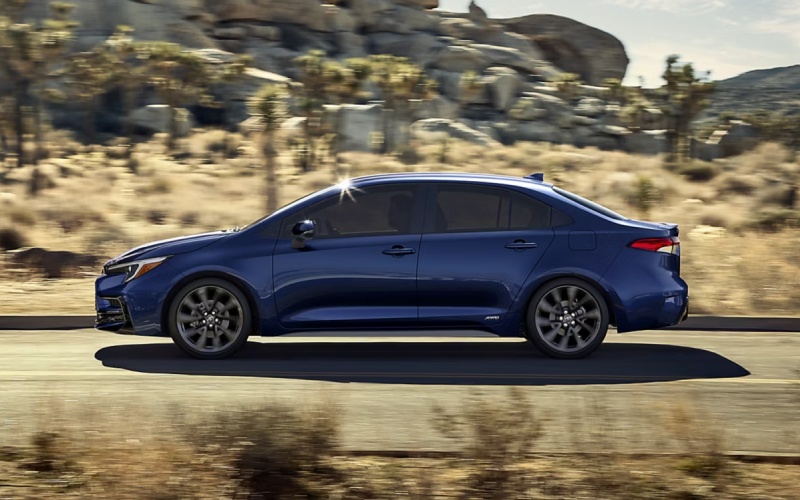
Heart City Toyota - Which Sedan Gives Better All-Weather Confidence—2026 Toyota Corolla or 2026 Hyundai ELANTRA for Mishawaka, IN Drivers?
What local shoppers mean by “all-weather confidence”
When shoppers around Mishawaka, IN ask which sedan feels more composed when roads get slick or surfaces turn patchy, they’re looking for more than just traction. They want a car that communicates clearly at the wheel, keeps power delivery smooth, and supports them with driver-assist tech that never feels intrusive. In that context, the 2026 Toyota Corolla stands out for one rare advantage in the compact-sedan class: available Electronic On-Demand All-Wheel Drive on Hybrid grades. ELANTRA brings strong safety tech and tire choices, but it remains front-wheel drive only across the lineup.
All-wheel drive isn’t just for deep snow or gravel lots. In day-to-day driving, AWD helps a car feel more settled the moment the front tires start to slip—on a damp manhole cover, painted lane markers in a downpour, or a sandy shoulder near a neighborhood curb. By routing power to the rear wheels through a dedicated electric motor when needed, Corolla Hybrid’s AWD system adds a layer of composure you can sense in your fingertips and seatback, then gets out of the way the moment the grip returns. ELANTRA’s well-calibrated traction control works to limit wheelspin, but it can’t send torque rearward because it has no rear-drive hardware.
How Corolla’s AWD works—and why that matters
Toyota’s Electronic On-Demand AWD is straightforward and smart. There’s no lever or dial to engage. Sensors monitor wheel slip and other inputs, then the system instantly adds rear-axle assistance to help you keep moving confidently. Because that rear motor only steps in as needed, the car retains its smooth, efficient character in normal driving. It’s not off-road hardware, but it’s exactly the backup you want when wet leaves cover a side street, when a steep driveway has loose pebbles, or when a hilly neighborhood intersection gets polished by traffic.
HYUNDAI’s approach with ELANTRA focuses on front-drive traction aided by stability and brake-based controls, which are effective at preventing wheelspin and keeping the car tracking straight. For many conditions, that’s all you’ll need. The distinction shows up at low speeds on split-grip surfaces—one side of the car on slick pavement, the other on dry—or launching from a stop on a crowned, damp street. Corolla Hybrid’s ability to feed some power to the rear can help it surge forward more cleanly and with fewer corrective steering inputs from the driver.
What about powertrains, tires, and drive modes?
Beyond AWD, power delivery and calibration shape all-weather feel. Corolla offers a 2.0-liter 4-cylinder with a Dynamic-Shift CVT that blends a physical first gear for natural launches with smooth, stepless acceleration afterward. The Hybrid powertrain runs quietly and confidently, and with Drive Modes—Normal, Sport, and Eco—you can choose a throttle map that best suits surface conditions. ELANTRA counters with a 2.0-liter 4-cylinder on most trims, a turbocharged 1.6-liter on the N Line for quicker responses, plus hybrid variants tuned for calm commuting. Both sedans offer all-season tires, though specific traction and braking performance vary by trim. The key differentiator stays the same: only Corolla Hybrid adds an available rear-axle assist for traction when the front tires protest.
Steering and braking also influence confidence. Corolla’s Electric Power Steering is light and precise in tight quarters, then settles nicely on the Bypass, so you can maintain trajectory with minimal hand movement in heavier weather. Ventilated front discs and well-tuned pedal feel provide consistent responses when you need to ease speed mid-corner or stop smoothly behind traffic. ELANTRA keeps a composed demeanor as well, with certain trims tuned for a sportier edge; however, the steering’s centering force and brake pedal feel can vary slightly by tire and wheel package. Try both back-to-back to sense the difference in your hands and feet.
Safety tech that supports—not distracts
Both sedans are well equipped. Every Corolla includes Toyota Safety Sense™ 3.0—Pre-Collision System with Pedestrian Detection, Lane Tracing Assist, Full-Speed Range Dynamic Radar Cruise Control, Lane Departure Alert with Steering Assist, Automatic High Beams, and Road Sign Assist. ELANTRA’s Hyundai SmartSense brings comparable capabilities, including Forward Collision-Avoidance Assist, Lane Keeping and Lane Following Assist, Blind-Spot Collision Warning, and more, with Highway Driving Assist on top trims. The takeaway is that both cars offer advanced assistance; Corolla’s across-the-board standardization keeps the feature set steady no matter which configuration you pick.
Inside, clear information delivery matters when conditions are busy. Corolla’s available 12.3-in digital gauge cluster and available 10.5-in Toyota Audio Multimedia touchscreen make it easy to glance, confirm, and move on, while standard wireless Apple CarPlay® and Android Auto™ help keep cords out of the way when you’re layered up with gloves and a jacket. ELANTRA’s available dual 10.25-in displays create a wide, cinematic panel, and the interface is intuitive; just remember that wireless smartphone integration is tied to the 8-in system on specific trims.
How to choose confidently if you’re comparing both
If all-weather traction is near the top of your list, start by test-driving a Corolla Hybrid with available Electronic On-Demand AWD, then an ELANTRA equipped with your preferred tire and wheel package. Drive your usual routes—residential streets, a stretch of the Bypass, and a quick stop in a tight parking lot—and focus on launch smoothness, steering stability, and how relaxed you feel when surfaces change. Notice how driver-assist alerts fade into the background once you settle into a rhythm, and whether the displays make it easy to confirm the next turn or lane choice without distraction.
Finally, factor in ownership support. Every new Toyota includes ToyotaCare, a no-cost maintenance plan with 24-hour Roadside Assistance for two years. That’s one more way Corolla keeps stress levels down over time. When you blend everyday traction with simple-to-use tech and long-run dependability, the case for Corolla builds quickly.
Frequently Asked Questions:
Does the 2026 Hyundai ELANTRA offer all-wheel drive?
No. ELANTRA is front-wheel drive only across gas and hybrid trims.
Which Corolla models offer AWD?
AWD is available on Corolla Hybrid grades via Toyota’s Electronic On-Demand AWD system, which automatically adds rear-axle assistance when the front tires slip.
Can driver-assist features replace AWD?
Driver-assist tech helps maintain lane position and can reduce wheelspin using brakes, but it doesn’t send power to the rear wheels. AWD adds another layer of traction that you can feel when surfaces get slick.
Next steps
Have more questions about traction, tech, or trims? Our team at Heart City Toyota is ready to help you map features to your daily routine and set up a back-to-back drive so you can feel the differences for yourself. We’re proudly serving South Bend, Mishawaka, and Goshen with straightforward guidance and a test-drive route that reflects real local conditions.